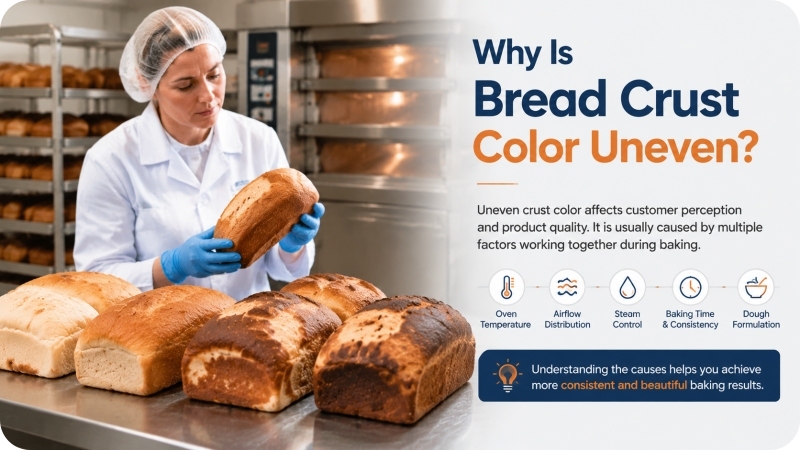
A beautiful golden-brown crust is one of the most important quality indicators of baked products. Customers often judge bread quality before tasting it, and crust color strongly influences their perception of freshness, texture, and baking quality.
However, many bakeries experience a common problem: the same recipe produces different crust colors from batch to batch. Some loaves may appear too pale, while others develop dark spots, uneven browning, or burnt areas.Uneven bread crust color is rarely caused by one single issue.Understanding these factors helps bakeries improve appearance, reduce product variation, and achieve more reliable baking results.
Why Does Bread Develop Color During Baking?
Before solving uneven browning, it is important to understand how bread gets its color.
Bread crust color mainly comes from two reactions:
Maillard Reaction
The Maillard reaction occurs when amino acids and reducing sugars react under heat. This creates hundreds of flavor compounds and produces the attractive golden-brown color associated with baked bread.
Caramelization
Caramelization happens when sugars break down at high temperatures, creating deeper colors and sweet, roasted aromas.
The final crust color depends on:
• Baking temperature • Baking time • Sugar content • Protein content • Dough moisture • Steam conditions
Any change in these factors can influence the final appearance.
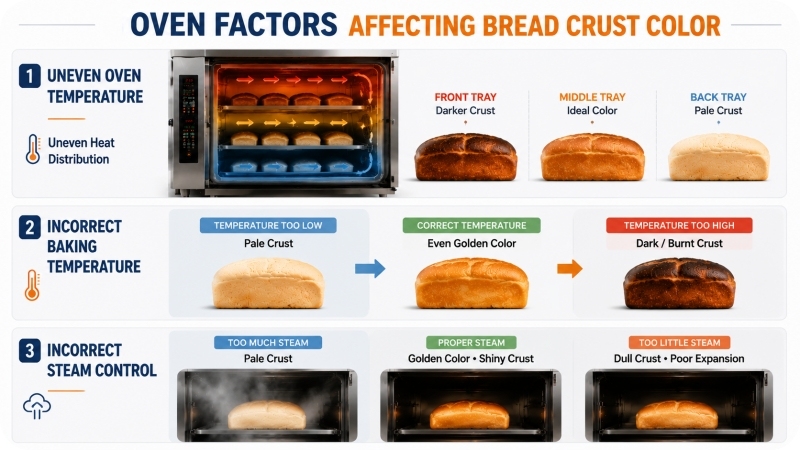
Cause 1: Uneven Oven Temperature Distribution
One of the most common causes of uneven crust color is inconsistent heat inside the oven.
Commercial ovens rely on controlled heat transfer. If different areas of the baking chamber have different temperatures, products placed in different positions may bake differently.
Common signs include:
Possible reasons include:
For commercial bakeries, consistent heat distribution is essential because hundreds of products must achieve the same appearance every day.
Cause 2: Incorrect Baking Temperature
Temperature has a direct influence on crust formation.
If the oven temperature is too low:
If the oven temperature is too high:
The ideal baking temperature depends on the product type, dough formulation, size, and moisture content.
A sandwich loaf and a rustic artisan bread may require completely different baking conditions even if both are made from wheat flour.
Cause 3: Incorrect Steam Control
Steam plays an important role during the early stage of baking.
In many bread products, steam helps keep the dough surface flexible, allowing better expansion before the crust sets.
Steam affects:
• Crust thickness • Surface shine • Color development • Texture
Too much steam may delay browning and create a pale crust.
Too little steam may cause the crust to set too early, reducing expansion and creating a dull appearance.
Professional bakeries carefully control steam levels according to the product being baked.
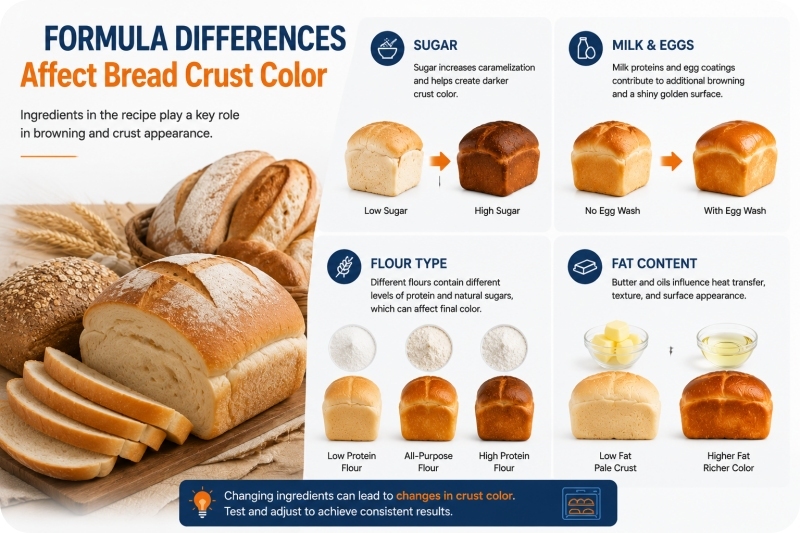
Cause 4: Formula Differences
The recipe itself has a major impact on crust color.
Ingredients that influence browning include:
Sugar increases caramelization and helps create darker crust color.
Sweet breads, milk bread, and brioche usually brown faster than lean bread.
Milk proteins and egg coatings contribute additional browning reactions.
This is why products brushed with egg wash often develop a shiny golden surface.
Different flours contain different levels of protein and natural sugars, which can affect final color.
Butter and oils influence heat transfer, texture, and surface appearance.
When changing ingredients, bakeries should expect possible changes in crust color.
Cause 5: Overproofing and Underproofing
Fermentation also affects crust color.
Overproofed Dough
Overproofed dough often has weaker structure and may produce:
• Pale crust • Flat shape • Reduced oven spring
Because the dough structure cannot expand properly, surface development changes during baking.
Underproofed Dough
Underproofed dough may expand aggressively in the oven and develop uneven surface tension.
Both situations can create inconsistent appearance.
Proper proofing requires control of:
• Temperature • Humidity • Time • Dough condition
Cause 6: Incorrect Loading and Oven Management
How products are placed inside the oven can influence results.
Common mistakes include:
Air needs enough space to circulate around products. Poor loading practices can create hot and cold zones.
For high-volume production, operators should follow standardized loading procedures.
Conclusion
Uneven bread crust color is usually a sign that one or more parts of the baking process are not fully controlled.The solution is not simply increasing oven temperature or extending baking time. Consistent color comes from controlling ingredients, dough development, fermentation, oven conditions, and production procedures together.
FAQ
1. Why is my bread crust color uneven?
Uneven crust color is usually caused by uneven oven heat, poor airflow, incorrect steam, inconsistent proofing, formula variation, or improper tray loading.
2. Why is one side of my bread darker?
One-sided darkening often points to uneven heat direction, tray position, blocked airflow, or oven loading imbalance.
3. Can proofing cause uneven crust color?
Yes. Under-proofed, over-proofed, or surface-dried dough can brown differently during baking.
4. How can commercial bakeries fix uneven browning?
They should check oven calibration, airflow, steam settings, tray spacing, proofing humidity, formula accuracy, and product color by oven position.
5. Should I bake longer to fix pale bread?
Not always. Longer baking may over-darken other areas. Find the root cause before changing baking time.
Looking for More Consistent Baking Results?
With 47 years of manufacturing experience and exports to 120+ countries, we help bakeries improve product consistency and production efficiency.

HONGLING provides complete bakery solutions including: • Dough Sheeters • Dough Proofers • Rotary Rack Ovens • Deck Ovens • Spiral Mixers • Cooling Solutions
Contact our team today to discuss your bakery project and receive a customized solution.
subscribe to us, you can get our latest product content, exclusive news reports and updates, the latest local events


online service





 +8613066853339