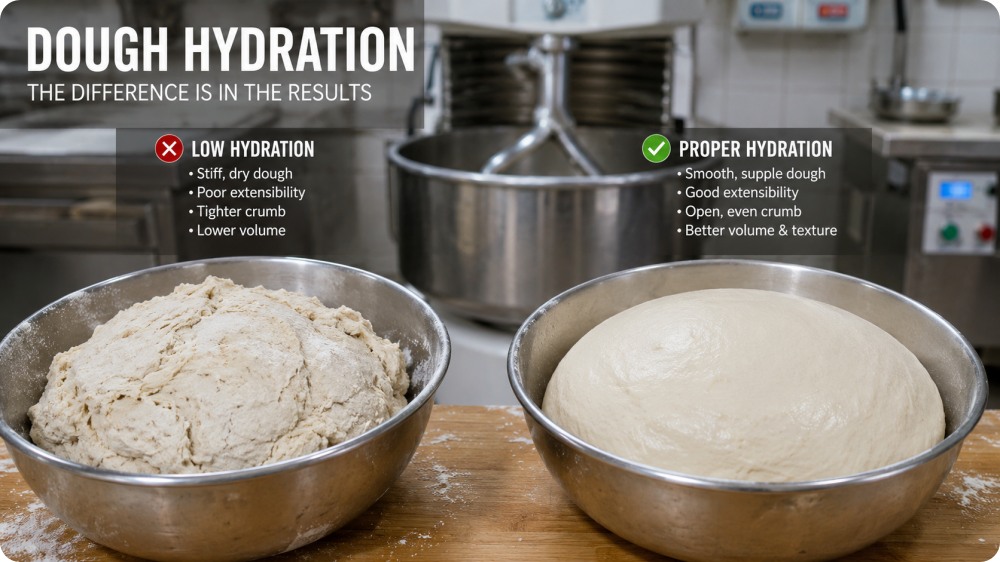
Water may look like the simplest ingredient in bread dough, but it has one of the biggest effects on the final product. A small change in water quantity can alter dough texture, mixing behavior, fermentation speed, crust color, crumb structure, oven spring, and even how easy the dough is to process.
Understanding hydration gives bakery teams a practical way to move from reactive correction to repeatable production. Instead of adding water by feel or adjusting flour at the last minute, the process can be measured, recorded, and improved.
What Is Dough Hydration?
Dough hydration refers to the amount of water in a dough compared with the amount of flour. It is usually expressed as a percentage.
For example:
The hydration level is 65%.
In baker’s percentage, flour is always treated as 100%. Every other ingredient is calculated as a percentage of the flour weight.
Hydration Formula:
Water Weight ÷ Flour Weight × 100 = Hydration Percentage
This method makes recipes easier to scale. Whether a bakery is producing 5 kg of dough or 100 kg, the same hydration percentage can be maintained.
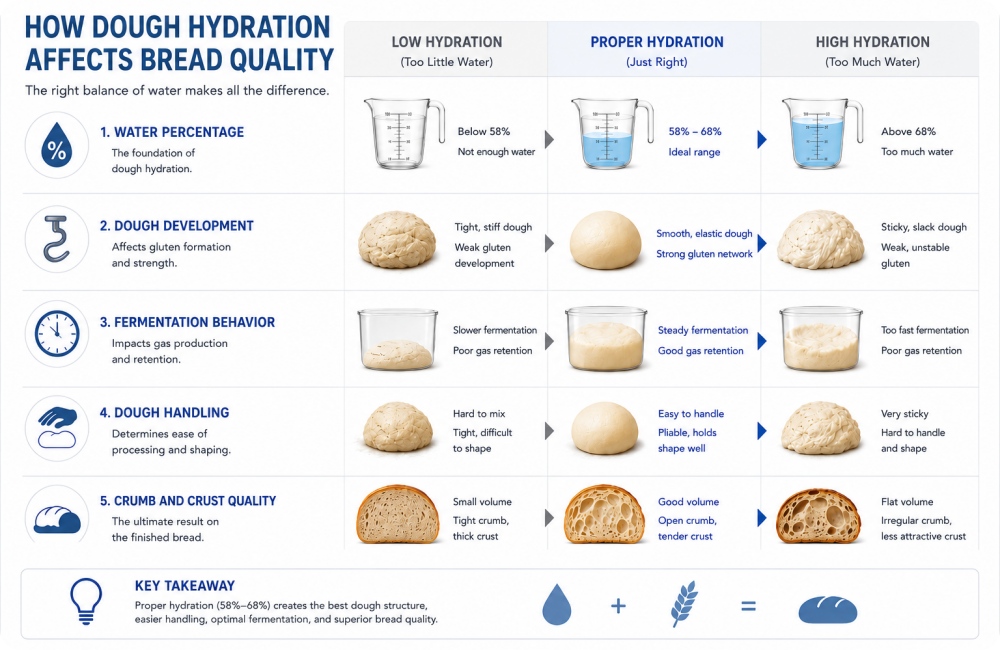
Lower-hydration doughs usually contain less than 55% water. They are often used for products that require a tighter crumb or more controlled shape, such as bagels, crackers, and some pastry bases. However, dough that is too dry may resist expansion, develop unevenly in the mixer, and produce a dense eating texture.
Medium-hydration doughs usually range from about 58% to 68%. This is a common range for many standard bread products,such as burger buns,basic pizza dough and many soft bread products.This range offers a good balance between dough strength, handling ability, volume, and crumb softness.
Higher-hydration doughs are usually above 70%. They can also be more difficult to divide, mold, sheet, or transfer. In a commercial setting, a hydration level that works in a small test batch may create handling problems at higher output unless the mixer, conveyor, sheeter, and operator workflow are designed for it.
How Water Affects Gluten Development
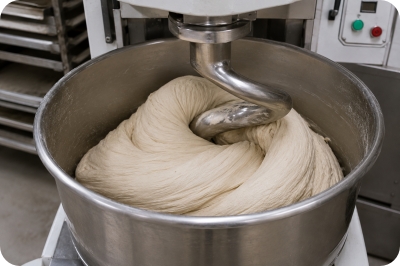
When flour and water are mixed, two important proteins in wheat flour—gliadin and glutenin—begin to combine and form gluten. Gluten creates the elastic network that allows dough to hold gas during fermentation.
With enough water, gluten can develop properly and create a flexible structure. This helps bread rise well and produce an open, light crumb.
However, more water does not always mean better gluten development. Very wet dough requires more careful mixing and handling. If the dough is not mixed enough, it may lack strength. If it is mixed too aggressively, especially at high temperature, the gluten structure can weaken.
For this reason, hydration and mixing must be considered together. A high-hydration dough often needs a suitable mixing process, resting time, or folding method to build strength without overheating the dough.

Why the Same Hydration Can Still Produce Different Results
A hydration number is useful, but it is not the whole story. Flour absorption can vary by wheat source, protein level, milling characteristics, storage conditions, and season. Two flour deliveries may require slightly different water additions to reach the same dough feel and performance.
Water temperature matters as well. In commercial bread production, it is often used to help manage final dough temperature. If incoming flour is warm or the mixer generates more friction than expected, using the same water quantity at a different temperature can change fermentation behavior.
Equipment makes this control practical. Accurate weighing systems, reliable mixers, programmable mixing cycles, and consistent proofing conditions reduce the variables operators must correct manually. The objective is not to remove craftsmanship; it is to give the production team a stable process that can be repeated across shifts.
Conclusion
Water changes far more than dough softness. It shapes gluten development, fermentation behavior, handling performance, and the final eating quality of bread. For a bakery, hydration should be treated as a controlled production parameter rather than a last-minute adjustment.
When hydration is measured accurately and supported by reliable mixing, proofing, and baking equipment, bakeries can produce more consistent bread with less waste and fewer production surprises. This is especially important for bakeries serving hotels, supermarkets, restaurant chains, and distributors, where customers expect the same product appearance every day. The recipe may begin with flour and water, but repeatable quality depends on how precisely the entire process is managed.
Looking for More Consistent Baking Results?
With 47 years of manufacturing experience and exports to 120+ countries, we help bakeries improve product consistency and production efficiency.

HONGLING provides complete bakery solutions including: • Dough Sheeters • Dough Proofers • Rotary Rack Ovens • Deck Ovens • Spiral Mixers • Cooling Solutions
Contact our team today to discuss your bakery project and receive a customized solution.
subscribe to us, you can get our latest product content, exclusive news reports and updates, the latest local events


online service





 +8613066853339